Nutra spying in Europe: finding top creatives in Tyver using Webvork offers
Europe stands out from other regions thanks to its high approval rates in the nutra vertical and its wide variety of GEOs. Here, you can always find a country whose mentality feels familiar and whose language you understand — and focus your efforts there.
Important advantage of the European Union: spy tools provide extended statistics for EU ads — including the gender and age of the audience targeted by each campaign.
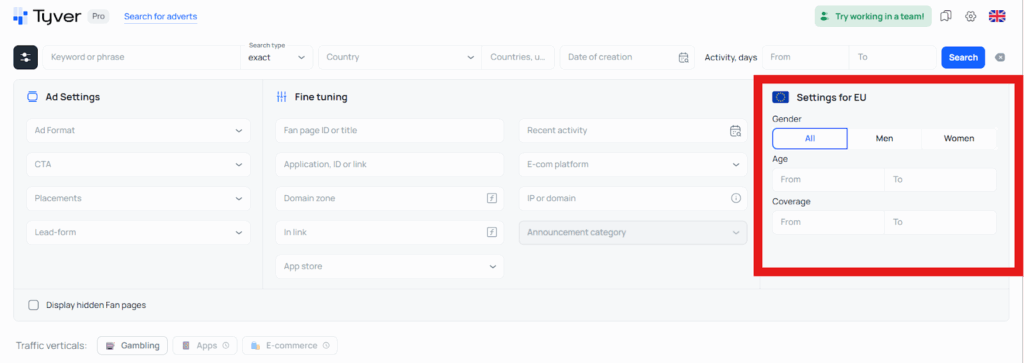
Traffic in Europe is expensive, and testing can quickly become costly — which means it’s wiser to use proven approaches and successful combinations from other marketers, adapting them to your own style. The best way to do this is by studying competitors’ ads. Let’s explore this process using the Tyver spy tool as example. We’ll focus on three offers with notably high approval rates for today’s market:
- Reprostat — 37% in Germany (creative selection here);
- ARTROFLEX Cream — 30% in Sweden (creative selection here);
- Parazax Complex — 40% in Austria (creative selection here).
Analyzing the overall tone of advertising in European GEOs
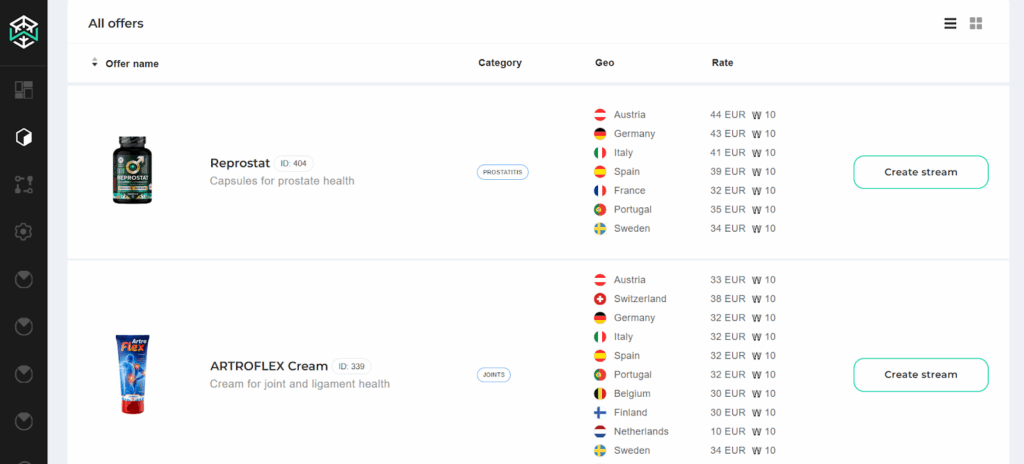
Harsh, aggressive offers and flashy colors don’t always work well in Europe. It’s better to start by examining which types of ads perform best and gain the most views overall. For example, let’s take Germany, Sweden, and Austria. In Tyver, set the targeting to these countries and sort the results by reach and active days. This sorting helps bring to the top the creatives that are:
- the most attention-grabbing (highest reach);
- the most effective (longest running time).
As we can see, the most common ad formats in these three countries are:
- videos explaining the essence and benefits of the product or service;
- a clean background with a clear list of advantages;
- a product image with plenty of empty space, where explanations are placed in the caption rather than on the picture itself.
Typically, pastel tones and high-resolution visuals are used. The accompanying text is minimal — short phrases of one or two words, with very little overall copy. A notable portion of the top-performing ads are in English.
Exploring health-related advertising
More specifically, let’s look at ads for prostate health, joint care, and anti-parasite products — the same offers mentioned above. To start, use the German keyword “prostata beschwerden” (“prostate complaints”).
In prostate-related ads, static creatives are used most often — featuring short taglines of one to three lines and images of:
- adult men,
- the product packaging,
- doctors,
- or anatomical visuals.
Muted shades of blue, green, and orange dominate the color palette. Occasionally, there are subtle metaphoric hints at ejaculation — for example, visuals with volcanoes or flowing lava.
For joint-related products, use the Swedish keyword “ledvärk” (“joint pain”).
In the joint-pain category, a large share of the search results consists of video creatives. The colors are not bright but rather natural and earthy, suggesting that the remedies are made from organic ingredients. Women are the predominant figures in both images and videos.
In the parasite-treatment niche, there’s no unified color or textual style; however, many ads include references to household pets.
To sum up, health-related advertising typically features:
- images of the target audience, doctors, and product packaging;
- short, concise taglines;
- muted or naturally toned color palettes.
Now let’s move on to specifics — namely, the search for actual affiliate creatives.
Spying by offer names and thematic keywords
After examining the general advertising landscape, you can move on to searching for actual ad sources tied to specific offers. In our example, these are:
- Reprostat — a remedy for prostatitis;
- ARTROFLEX Cream — a joint care cream;
- Parazax Complex — an anti-parasite treatment.
To start, try entering the offer names directly into the search bar, using a broad match type of query.
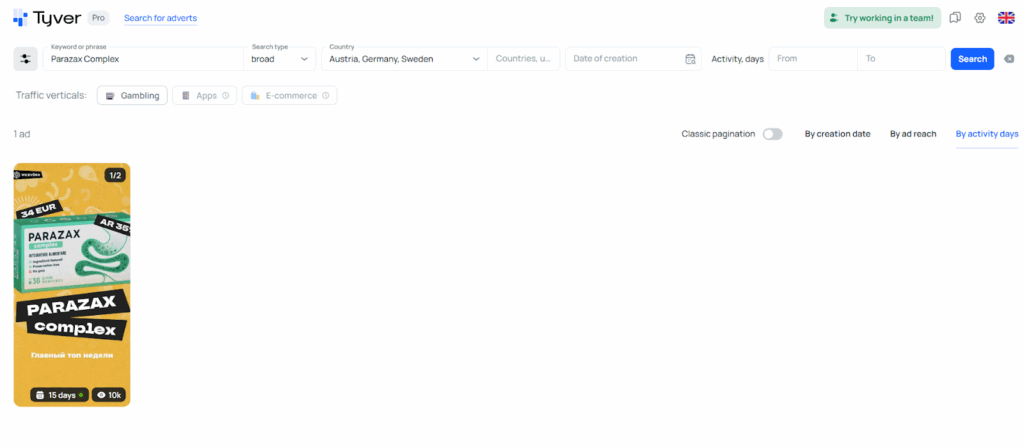
As we can see, searching by offer names yields very few ad examples. You can increase the number of results by removing the GEO targeting restriction — although that doesn’t always help. For instance, when searching for Parazax Complex, the number of creatives doubles — from just one to a whole two.
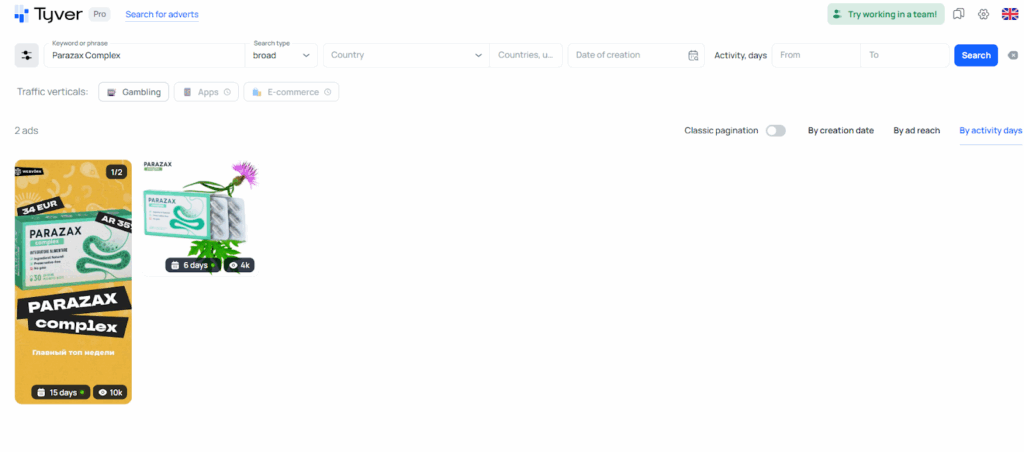
To find more targeted ads, you can search by thematic keywords, demographic filters, and link identifiers. For example, let’s look for prostate treatment ads. If you enter the keyword “prostatitis”, you’ll get a flood of irrelevant results — ads from blogs, news outlets, clinics, and private doctors, rather than affiliate campaigns.
You can remove all this “junk” from the search results and keep only affiliate creatives by adding tracking parameters to the link filter and narrowing down the audience by gender and age.
To track traffic, affiliates commonly use identifiers such as:
- ad_id=
- utm_source=
- pixel_id=
- sub
- adset.id
- ad_campaign
- campaign_id
At the same time, prostate-related products are usually targeted at men aged 35 and above, and within the EU you can set this demographic filter in the ad search. Let’s try applying the search settings shown in the screenshot below.
As a result, we see an entire feed of targeted affiliate ads — some of them quite bold and straightforward in their messaging.
In the same way, it’s easy to find creatives for the “joints” and “parasites” niches. For joint-related advertising, it’s recommended to narrow the audience by age — 40+, without dividing by gender. For parasite-related offers, you don’t need to set any age or gender restrictions.
As for keywords, they can often be found directly on the offer’s landing page or product card.
If necessary, a keyword can be translated into another language.
What are “related ads” for?
This feature helps you find all the creatives launched by a specific advertiser. Open any ad from the keyword search results and scroll down slightly. In the “related ads” section, click on any creative — for instance, an image featuring a glass of water.
As a result, a new page opens showing all the ads launched from the same fan page — and most likely by the same advertiser.
In this example, there are only 46 ads — all related to prostatitis. However, it’s often the case that a single fan page runs campaigns across multiple affiliate niches, making it a valuable source of insights for discovering new angles and testing hypotheses.
In conclusion
Everything described above is not a strict “how-to manual,” but rather a general roadmap for working with spy tools — illustrated here with Tyver. Instead of relying on a single keyword and a few tracking-ID filters, you can generate numerous thematic search queries with ChatGPT, and some of them will lead you to a wide range of affiliate creatives.
A spy service can also be used simply as a market-research and idea-generation tool — to uncover trends and potential combinations even without focusing on a specific offer. The ability to sort results and filter by GEO and audience demographics makes spying an essential part of offer selection and pre-test preparation.