VSL Landing Pages in Nutra
VSL landing pages have been used in nutra for a long time, but many affiliates still see them as something complicated or “not for everyone”. In reality, it’s just another landing page format — with its own pros and cons.
When you understand why you need a VSL and how to build it properly, it can deliver stable performance and bring in high-quality traffic. But if your funnel is poorly structured, you can easily burn the entire budget.
In this article, we’ll break down how to work with VSLs the right way.
What a VSL is and why it works in nutra
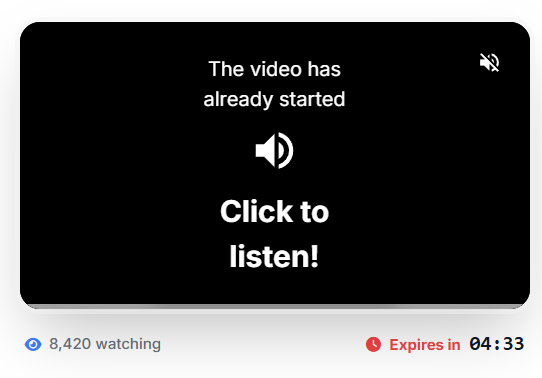
A VSL is a landing page where the main selling job is done by a video. In most cases, it’s a long video — often 20 minutes or more. The video can’t be skipped, so the user is forced to watch it through and move step by step through the entire funnel.
This format works especially well in nutra because it allows you to warm up cold traffic, explain the product in detail, and handle objections before pushing the user to take action.
This works well in nutra for a simple reason: the product usually needs explanation. People want to understand why it should work specifically for them, how it’s different from everything they’ve already tried, and why they can actually trust it.
Video lets you walk the user through all of this step by step — calmly, without pushing for a sale in the first few seconds and without overwhelming them with walls of text.
Why a VSL is more than just “a video on a landing page”
A common mistake is thinking that a VSL is just a regular landing page with a video slapped on top. In reality, the difference goes much deeper.
On a classic landing page, the user decides what to read and in what order. With a VSL, you control the flow. The user either watches the video and gradually gets pulled into the funnel, or they leave the page.
That’s why the first seconds, the script logic, and the way you build interaction with the audience matter so much.
What a good VSL landing page is built from
Most VSLs follow the same core structure, even if different marketing formulas are used. The video takes the user on an emotional ride — hitting triggers, pressing on pain points, and slowly leading them toward the decision.
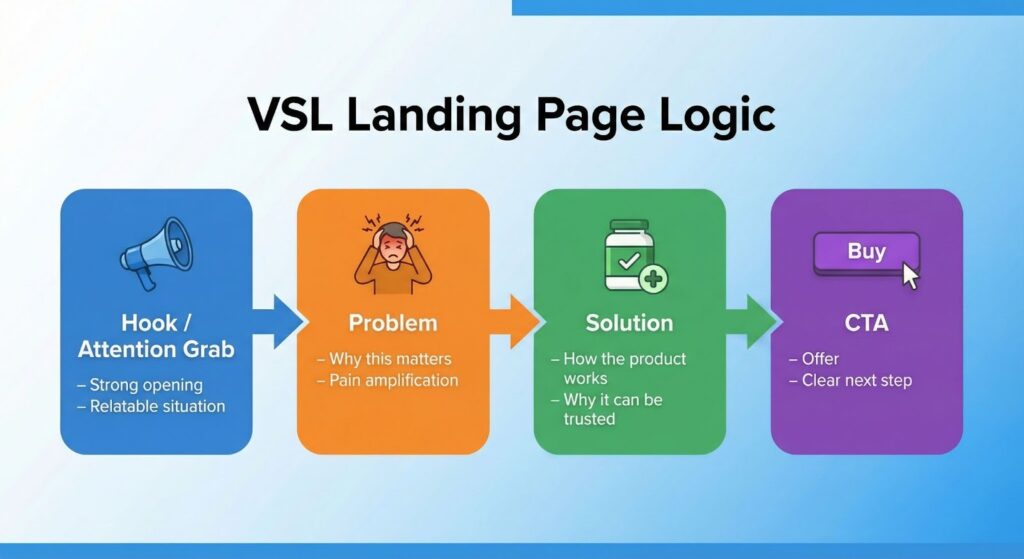
At the very beginning, the goal is to grab attention. The first seconds of the video are critical. There’s no room for warming up or generic intros — the user has to immediately recognize that the video is about their problem.
Next comes a deeper dive into the pain or situation. It’s important to show that the person in the video understands the audience — their fears, doubts, and negative past experiences. This is what creates the “they get me” feeling.
After that, the reason behind the problem is explained. The explanation should be simple but authoritative. This is usually where a second character appears: a doctor, researcher, or product expert who adds credibility to the story.
Then the product is introduced — not as a direct ad, but as a natural continuation of the narrative. The key here is to show why this product is different from everything else on the market.
Next come the boosters: trust elements, social proof, guarantees, and objection handling. And only after that does the video move to a clear call to action.
In a strong VSL script, the focus is on benefits, not features. Users don’t really care how many milligrams are inside the capsule — they care about what will change in their life and how fast they’ll feel the result.
The script should move smoothly from problem to solution, not jump between random talking points. If the viewer doesn’t understand how the speaker arrived at a certain conclusion, trust drops immediately.
You can strengthen the script with hooks, exaggerated examples, and even a bit of dramatization. The goal is to grab attention first — sometimes even scare the viewer — and then lead them toward the “right” solution.
It’s also important to bake objection handling directly into the script. “I’ve already tried everything”, “this isn’t for my age”, “it won’t work for me” — all of these objections should be addressed inside the video, not left for later.
Visuals and delivery
In a VSL, visuals should never distract from the message. Overly complex animations, aggressive transitions, and overloaded screens usually do more harm than good. At the same time, a pure “talking head” video isn’t ideal either — there should be enough movement and visual change to keep the viewer focused and engaged.
The formats that work best are the ones that feel close to real human communication: a real person on screen, a calm background, confident delivery. Use animation and infographics to support the explanation, not replace it.
Pacing also matters a lot. If the video is too slow, users drop off. If it’s too fast, they don’t have time to understand what’s going on. A good VSL keeps a balance between clarity and momentum. Subtitles are a must — a large part of the audience watches videos without sound, especially on mobile.
VSL Analytics and Optimization
Work on a VSL doesn’t end after launch. That’s when it actually starts.
Key metrics to track:
- Video retention — watch completion at 25/50/75%. If most users drop early, the hook needs work.
- Time on page — shows how engaged users are. Short time usually means weak content or a confusing structure.
- CTR on buttons and CTAs — helps you understand how users react to your call to action.
- Completion of key blocks — highlights weak spots in the script.
- Conversion rate — the final metric that shows how effective the whole VSL really is.
Even small tweaks to the script, visuals, or CTA can lead to noticeable conversion gains. Always look at metrics together, not in isolation — that’s how you find where users are actually dropping off.
Common mistakes when working with VSLs
One of the most common mistakes is a long, vague intro. The opening lines should be provocative, intriguing, or unexpected (in a good way).
The second mistake is overdoing the “science”. Complex terminology and over-explaining don’t build trust — they usually create skepticism.
The third mistake is the lack of a clear call to action. A user might be ready to buy but simply doesn’t understand what to do next.
In practice, these videos are usually produced in two ways: either by hiring actors and doing a full shoot, or by generating the video using AI. Filming is often time-consuming and expensive, so in many cases it’s more efficient to work with a strong designer and order a high-quality video from them. There are also agencies that can handle everything end-to-end — from script to landing page and video production.
When VSLs are really worth using
VSL landing pages work best for offers where explanation, trust, and gradual warm-up matter. It’s not the fastest format, but when done right, it’s one of the most stable ones.
If you invest time and effort into proper preparation, VSLs can bring in high-quality leads and strong approval rates.