Meta Ads: the new metric “Opportunity Score” — how to use it as an arbitrage trader

Meta keeps upgrading its ad suite, and one of the newer tools is Opportunity Score. Think of it as a “potential index” for your campaigns: it shows how well (or poorly) you’re leveraging Meta’s ecosystem.
For an arbitrage player, it’s handy — helps you spot weak spots fast and figure out where you might squeeze extra traffic or conversions without dumping more budget. The trick is knowing how to read it — and when not to lean on it too hard.
What is Opportunity Score
Opportunity Score is a 0 to 100 scale Meta added into Ads Manager. The higher the number, the more Meta thinks your campaigns are “dialed in.”
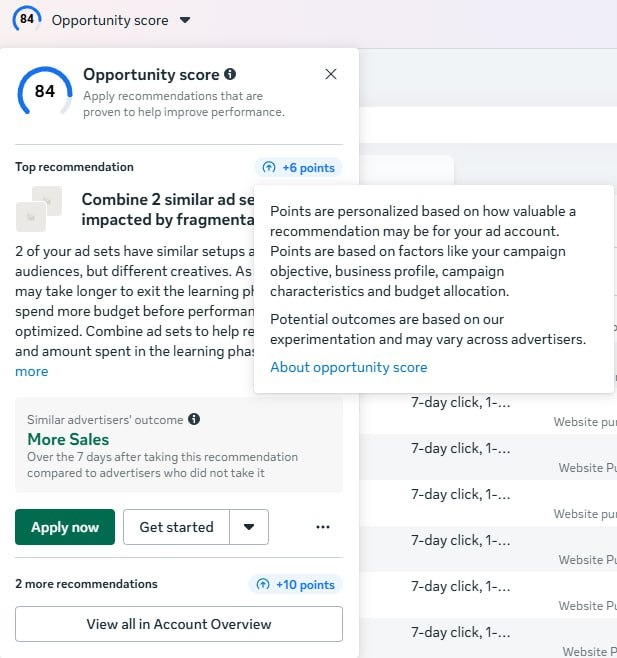
But it’s not a performance metric — it’s more like a setup health check. It evaluates how you’re using Meta’s ecosystem (Advantage+, CAPI, automation, etc.), whether your account has technical issues, and if you’re following Meta’s recommendations for campaign structure, audiences, budgets, and formats.
In simple terms, Meta is telling you: “Here’s what you’re doing right — and here’s what to fix so the algorithm can actually perform at full power.”
Where the score comes from
The Opportunity Score is based on Ads Manager’s internal recommendations. The system analyzes things like:
Campaign settings and bid strategies;
Ad structure;
Whether you’re using Pixel or CAPI;
Audience types and creative formats;
Policy compliance and ad quality scores.
Each issue has its own weight — Meta decides which factors are more “influential,” meaning which ones could have the biggest potential impact on performance.
For example:
- no CAPI connection — minus points;
- audience too narrow — another minus;
- not using Advantage+ Audience — minus again;
- perfect creative format — small bonus.
In the end, you get an overall score and a list of “opportunities for improvement.”
What Opportunity Score doesn’t measure
And here’s the key part: this metric has nothing to do with ROI, CPA, or CR.
It doesn’t measure whether your campaign is making money — it only checks how well you follow Meta’s playbook.
Opportunity Score doesn’t know your offer, your funnel, or what kind of creatives you’re testing. Its advice is averaged and standardized. So chasing 100% isn’t the goal — you can still make solid profit with a mediocre score.
How to actually use Opportunity Score in arbitrage
Don’t obsess over the number — look at what Meta recommends fixing. Go to Ads Manager → Campaign Overview, check the list of suggestions, and decide which ones actually make sense for your campaigns.
Break them down by priority:
1. Errors and warnings — fix right away (e.g., broken pixel, policy issues, wrong format).
2. Technical upgrades — test carefully (CAPI, Advantage+, etc.).
3. Best practices — those are Meta’s “official” rules, like using auto placements, not splitting audiences too much, and giving campaigns time to learn.
Follow them selectively — sometimes they help, sometimes they kill performance.
Don’t change everything at once. Make one or two improvements, let the campaign go through the learning phase, and track how it affects real metrics.
Keep notes — after a couple of weeks, you’ll see which tips actually improve results and which ones just bump your score “for the sake of the score.”
When Opportunity Score is useless
- Everything’s already working.
If your campaigns are stable and your CPA looks good — don’t break what’s working just to please the algorithm. A higher score won’t magically bring more leads. - You’re running gray or borderline offers.
In Nutra and Adult, Meta’s automated suggestions can trigger moderation issues. Always test before you roll out updates — and keep backup creatives ready. - You can’t read your own data.
If you don’t understand how your tweaks affect performance, chasing the score will just waste your budget. Learn to analyze your campaigns first — the metric comes second.
Conclusion
Opportunity Score is a handy feature — if you know what to do with it. It shows how closely your setup aligns with Meta’s logic and helps spot weak points before they start draining your spend.
But remember: it doesn’t replace analytics, creatives, or testing. Use it as a guide, not a final verdict. The real metric of success is still the same — profit on the sheet, not a perfect score in Ads Manager.